Perspectives During Market Volatility

- So far in 2025, the S&P has been down as much as 18% YTD and more than 20% from the 2025 high. (Stocks have experienced a slight recovery since these lows and are down approximately 10% YTD as of 4/22/25.)
- The media is quick to highlight short-term turbulence but rarely comments on the market's long-term potential for wealth accumulation.
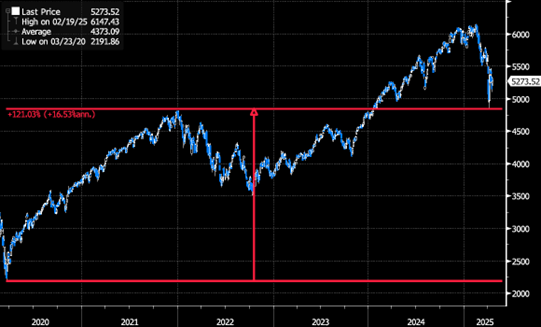
- The cumulative return of the S&P 500 over five years is more than 100%, even after accounting for the 2022 volatility (the market was down approximately 18%) and the YTD volatility in 2025.
- Do not take financial advice from the media – they have no understanding of your individual financial strategy or circumstance.
- Just because the news is reporting that the major indexes are down sharply does not mean your investments have experienced a commensurate loss – you may have a mix of assets that provide diversification to hedge stock market volatility.
- Your individual investment strategy was likely established with the knowledge that negative market periods were not an “if” but a “when,” and built to withstand volatility.
- Suppose you are drawing on your portfolio to support your retirement lifestyle and do not wish to sell equities in the current environment. In that case, you may be able to lean on cash reserves or fixed income until the market recovers, avoiding selling stocks at a loss and subjecting the portfolio to sequence-of-returns risk.
- When considering making changes, it is usually not the answer to time the market by going to cash and attempting to re-enter later: even the most experienced professionals cannot predict market peaks or troughs.
- If changes are to be made, call your advisor to discuss opportunities to capitalize on in this environment (rebalancing, investing excess cash, Roth conversions, tax-loss harvesting, etc.). Additionally, there may be changes within your control that could be taken. Advantages of such an approach include implementing a dynamic spending approach (delaying the home remodel, postponing the vacation, etc.), which could lessen the extent of the overall decline in the portfolio balance between returns and withdrawals.
The stock market, as measured by the S&P 500, drifted more than 20% down from its high in 2025 before experiencing a slight recovery (the market (S&P 500) is down approximately 10% as of 4/22/25).
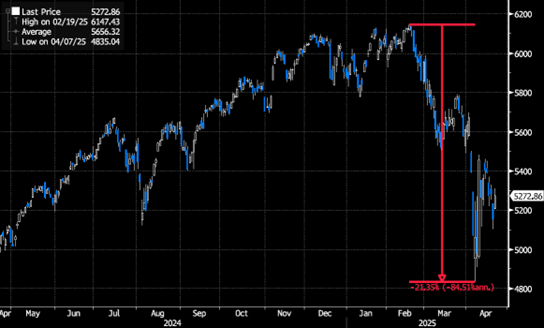
The media widely covered the market's movements in early April, and rightly so, as these moves are material and have immediate impacts on investors. What the press is less likely to emphasize is if an investor owned an ETF or index fund with underlying investments mirroring the S&P 500, even at the -20% decline from the recent high, that investment would have only been down about 2% over the prior 12-month period. Along the same lines, if the investor had purchased the S&P fund 5 years ago, their total return would be more than 100% (cumulative), even at that YTD low seen in early April.
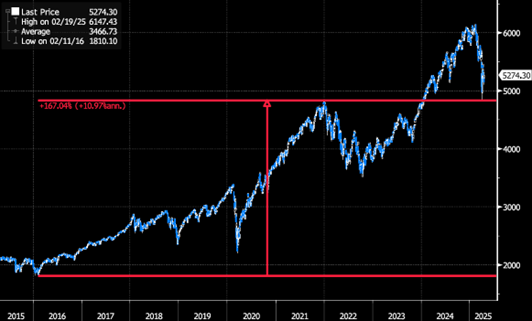
Similarly, if an investor entered the market 10 years ago, even considering COVID-19, the negative returns in 2022, and the YTD 2025 losses, the cumulative return of that investment would be well over 150% as of the 2025 YTD low.
When you are in the middle of a market decline, such as what was experienced during the beginning of the COVID-19 pandemic (-34%), or even the more gradual decrease of 2022 (-18%), it can incite feelings of anxiety and even panic. The media can perpetuate these feelings, not only through the continuous feedback loop emphasizing the levity of the situation, but also by hosting speakers who believe themselves to be giving sound financial advice, such as a recommendation to sell stocks and move to a money market or high yield savings, but whose advice cannot and should not be considered as such, since these guest hosts are speaking to the masses, and have no way of knowing an individual investor’s financial situation, financial strategy, or financial plan.
When you have several years of positive returns in the market, it is easy to fall into the trap of thinking that asset management and financial planning are uncomplicated. It is during years like 2020, 2022, and YTD in 2025 that highlight the importance of working with a qualified financial advisor. Suppose you are working with a qualified financial advisor held to a fiduciary standard. In that case, you likely can recall a conversation at your first meeting (and probably several similar discussions since then), during which you discussed your financial goals, your risk preferences, and your time horizon. You likely landed on a strategy that most closely aligns with your goals and your risk preferences.
If, for example, you and your advisor decided on a relatively balanced investment strategy (i.e. 50/50, 60/40, 70/30 (stocks/bonds)), then it is crucial to keep in mind that what you are seeing on the news (i.e. that the market is down more than 20% from its recent high mark), is not necessarily what is happening to your portfolio. For example, if you are invested 60/40 and the 60% that is in stocks has lost 20% (which also may not necessarily be the case depending on the portfolio style), and assuming that the bonds have not experienced any positive performance, but have merely held their value, that would imply only a 12% YTD loss on the overall portfolio. Oftentimes, during periods of stock market volatility, you will see bonds do well as investors flee the equity market in search of the relative safety of those securities.
Regardless of whether it is a 12% or a 20% unrealized loss, a common question during periods of excess volatility is: What changes need to be made? Generally, the number or extent of appropriate changes would be less than you might think. The reason for this is that your original investment strategy, regardless of the selection, style, or allocation, was put in place for both years like 2023 (S&P +26%) and 2024 (+23%) as well as periods like what we observed year-to-date in 2025 as of early April when the market was down more than 20% from its recent high. Those investors in a balanced portfolio are likely experiencing less severity in their portfolio’s negative return, and those investors who are aggressively allocated (i.e., 100% stocks) likely have a longer time horizon, which would historically imply a high probability of recovering and continuing to grow those investments for funding goals later in life. Additionally, suppose you are in a balanced portfolio. In that case, your advisor may rebalance if equities continue to decline (selling bonds while they’re doing well and moving the proceeds to purchase stocks at lower prices), which will also improve performance when the market begins to recover. Suppose you are making regular contributions to the account (whether balanced or growth-oriented). In that case, you will likely see a benefit when you look back from some future point in time and see how you were consistent in buying additional shares at lower costs, which can also create a slingshot effect when the market recovers.
Perhaps the most nervous investors are those with a more balanced strategy, who are already retired, and who rely on distributions from their portfolio to support their standard of living. While it is true that negative returns early in retirement can have far-reaching (negative) financial impacts on a retirement plan, there are usually steps to be taken to avoid realizing those negative returns so early in retirement. If you rely on a portfolio draw to support your current standard of living, you may have 6-12 months of that monthly draw in cash, which you can rely on during this turbulent period. If that becomes depleted and the market remains volatile, you could discuss with your advisor the possibility of liquidating only the fixed-income portion of the portfolio to cover next year. This would allow the equity allocation time to recover before returning to regular liquidation of those investments. Additionally, you may be able to mitigate this sequence-of-returns risk by cutting retirement spending (e.g., delaying a vehicle purchase by 1 year, holding off on a family vacation, or postponing a home remodel). Implementing dynamic expenditures in retirement, in which you adjust to favorable or unfavorable market conditions, can be extremely helpful in boosting the sustainability of the retirement plan.
In summary, for most investors, the only action that market volatility should spur is a call to your advisor to review your strategy. A review of your financial plan or financial picture may result in actions that take advantage of market volatility, such as putting sidelined cash to work, discussing Roth conversions, performing tax-loss harvesting, or reviewing opportunities within your asset allocation. It is important to remember that, in most cases, any short-term reactions (such as going to cash with the intention of reinvesting when the market bottoms out) are an attempt at market timing. The probability, even for experienced professionals, of timing both of those decisions (when to get out and when to get back in) is extremely low. Usually, it results in an unfavorable ending value relative to the consistent investor once everything has leveled back out. If you are working with a qualified advisor, you would probably agree that no promises were made that this would never happen; instead, strategies would be implemented so that, when this happens, the portfolio is prepared to withstand it. When your financial strategy requires those higher returns (8-10%) to outpace inflation and grow your investments, you get to enjoy the +26% and +23% that we saw in 2023 and 2024, but you sometimes experience the -18% that we observed in 2022. Stocks should always be allocated to fund those expenses on the farthest side of your retirement time horizon, and times like this are a good reminder.
Article Written By: